
| Título: | Minimal disease activity (mda) in patients with recent-onset psoriatic arthritis. Predictive model based on machine learning |
|---|---|
| Autores: | R. Queiró Silva, D. Seoane-Mato, A. Laiz, E. Galindez, C. A. Montilla-Morales, H. S. Park, J. A. Pinto Tasende, J. J. Bethencourt Baute, B. Joven-Ibáñez, E. Toniolo, J. Ramirez, A. Serrano García |
| Año: | 2022 |
Abstract
Background. Very few data are available on predictors of minimal disease activity (MDA) in patients with recent-onset psoriatic arthritis (PsA). Such data are crucial, since the therapeutic measures used to change the adverse course of PsA are more likely to succeed if we intervene early.
Objectives. To detect patient and disease variables associated with achieving MDA in patients with recent-onset PsA.
Methods. We performed a multicenter observational prospective study (2-year follow-up, regular annual visits), promoted by the Spanish Society of Rheumatology. Patients aged ≥18 years who fulfilled the CASPAR criteria, with less than 2 years since the onset of symptoms, were included. The intention at the baseline visit was to reflect the patient’s situation before disease progress was modified by the treatments prescribed by the rheumatologist.
All patients gave their informed consent. The study was approved by the Clinical Research Ethics Committee of the Principality of Asturias.
MDA was defined as fulfillment of at least 5 of the following: ≤1 tender joint; ≤1 swollen joint; PASI ≤1 or BSA ≤3%; score on the visual analog scale (VAS) for pain provided by the patient ≤1.5; overall score for disease activity provided by the patient ≤2; HAQ score ≤0.5; ≤1 painful enthesis.
The dataset contained data for the independent variables from the baseline visit and from follow-up visit number 1. These were matched with the outcome measures from follow-up visits 1 and 2, respectively. We trained a random forest–type machine learning algorithm to analyze the association between the outcome measure and the variables selected in the bivariate analysis. In order to understand how the model uses the variables to make its predictions, we applied the SHAP technique. This approach assigns a SHAP value to each value of each variable according to the extent to which it affects the prediction of the model.
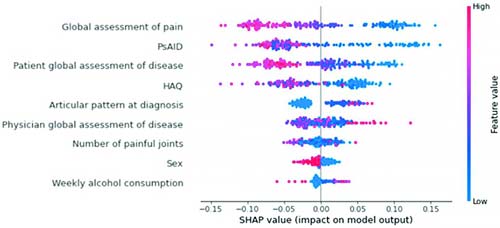
Results. The sample comprised 158 patients. 14.6% were lost to follow-up. 55.5% and 58.3% of the patients had MDA at the first and second follow-up visit, respectively. The importance of the variables in the model according to the mean of the SHAP values is shown in Table 1. The variables with the greatest predictive ability were global pain, impact of the disease (PsAID), patient global assessment of disease and physical function (HAQ-Disability Index). The SHAP values for each value of each variable are shown in Figure 1. The percentage of hits in the confusion matrix was 85.94%.
Si te interesa esta publicación, puedes descargarla: